 Loading... Please wait...

Categories
Categories
- Home
- Baroque Instruments (including pochettes)
- Violoncello da Spalla Standard Model by D. Rickert
Violoncello da Spalla Standard Model by D. Rickert


Violoncello da Spalla Standard Model by D. Rickert
)

Product Description
This model is less expensive than the new Violoncello da Spalla Standard Plus Model, which costs considerably more.
The two instruments are essentially the same. The Standard Plus Model is made by a single master luthier; whereas the Standard Model is partially made by apprentice luthiers and completed by a master luthier. Both instruments are professional performance level.
Please contact us if you wish to discuss purchasing one of these instruments.
Our email is don@DonRickertDesign.com and phone number is (706) 896-0909 or (706) 400-1481 (mobile). You can also use the "Contact" link on this page.
See the podcast 'Cool Instruments for Hep Cats'. Several recent installments, as well as several upcoming episodes are specifically about the Violoncello da Spalla, its history as well as playing technique:
- YouTube (video version): https://www.youtube.com/@Cool_Instruments_for_Hep_Cats/podcasts
- Spotify (audio version): https://podcasters.spotify.com/pod/show/cool-instruments-hep-cats
Violoncello da Spalla Standard Model by D. Rickert
See and hear some demonstrations of this exciting new instrument
The demonstrations below are but two of a large and growing number that can be seen and heard on our Violoncello da Spalla Demo Page.
The incredible Andrew Gonzalez performing on our Violoncello da Spalla by Don Rickert.
Heifetz 2018: Violoncello da spalla | Andrew Gonzalez Plays Bach
Introduction
After receiving inquiries about violoncellos da spalla for several years, we started making them on a custom basis in 2017, Due to their extreme popularity, we have making them on a regular basis since 2018. Our current production is 3 to 6 a year. We are taking steps to increase this number to 12 a year (one per month). We also make octave violins, octave mezzo violins, 5-string violins and our high-end travel violins. We also make the occasional octave mandolin and Irish bouzouki.
I currently make four models of full-size (approximately 18" body length) Violoncellos da Spalla:
- Violoncello da Spalla Standard Model by D. Rickert [this instrument] ($12.5K with special discounts available for accomplished players)
- Violoncello da Spalla Standard Plus Model (aka Deluxe Model) by D. Rickert (starts at $16.5K with special discounts available for accomplished players)
- This instrument has the same basic specifications as the Standard Model, but is completely hand-made by Master luthier, Dr. Donald Rickert in our workshop in Hiawassee, GA, USA, with no apprentice labor. It also has decorative touches not included with the Standard Model.
- Violoncello da Spalla Exhibition Model (soon to be formally announced on this site) (starts at $24K)
- Violoncello da Spalla Basic Model by D. Rickert (made in China with setup in U.S., about $4.5K).
- Note: Aside from rare exceptions, this instrument is ONLY available as a backup instrument for clients who already own one of my Violoncellos da Spalla made here in the North Georgia Mountains (US).
I also make a small format Violoncello da Spalla.
- Petite Violoncello da Spalla by D. Rickert (starts at $9K). This is a smaller format Violoncello da Spalla
My Violoncello da Spalla Standard is the model described here. This is the very same instrument being played in the above demos. It is similar to the 18” violoncello da spalla the famous instrument (1732) by Johann Christian Hoffman; however, the design is ours. One of our Violoncellos da Spalla is pictured here. This 5-string instrument is powerful and sonorous, regardless of whether it is strung with modern strings, gut strings or a mix, such as gut for the high three with modern lower two string.
Background: What is a Violoncello da Spalla?
The violoncello da spalla (Italian for “cello of the shoulder”) was, until fairly recently, a 5-string instrument of the violin family from the Baroque period that had fallen into obscurity. It is a small instrument, about the size of a modern 1/10 size cello, that is tuned to C, G, d, a, e’ (i.e. like a cello with an additional string on the treble side that is tuned to e’, which is an octave lower than the e” string on a violin)
It is thought by many that the violoncello da spalla was invented, or at least perfected, in the early 1700s. A now well-documented and widely-replicated instrument was made in 1732 by the German luthier, Johann Christian Hoffman, a contemporary and thought to be a close friend of Johann Sebastian Bach. Bach’s purported close relationship with J. C. Hoffmann has led to a now popular theory that Bach had a hand in the invention of the violoncello da spalla. This belief continues to be debated by experts who study the history of musical instruments. Other less well-documented instruments now considered to be early versions of violoncellos da spalla (in today's parlance anyway) were made in the 1600s. None of these instruments were called "violoncello da spalla" when they were new; well, probably not.
Anyway, what is now widely regarded as the primary candidate for distinction as the original actual violoncello da spalla, rather than just a large 5-string viola, having been previously classified as either a viola pomposa, viola da spalla or piccolo cello, was made in 1732 by Hoffmann. It is this instrument that, today, is the de facto “gold standard” for a proper violoncello da spalla. Most contemporary makers replicate at least the principle measurements of the Hoffmann instrument. Most builders that I know of apply knowledge gained in the past 300 years to things like the bass bar, tap tones and the like.
The modern resurrection of the violoncello da spalla, and widespread attribution of the instrument’s invention to Hoffmann, is due largely to the Russian-Dutch luthier and media celebrity, Dmitry Badiarov. Badiarov, based in The Hague, introduced his first violoncello da spalla in 2004, essentially after Hoffmann, albeit, considerably more refined, in my opinion, than the original 1732 instrument. While Badiarov, and his collaborator, Sigiswald Kuijken, are more well-known, it was earlier research by the Dutch violinist and violist, Lambert Smit, that laid the groundwork for Badiarov and others involved in the resurgence of the violoncello da spalla. Smit is regarded by many as maybe the the grandfather (with Badiarov the father maybe?) of the modern revival of the violoncello da spalla. No one can deny Badiarov the distinction of original Violoncello da Spalla Evangelist! But, it was Smit who first posited the involvement of Bach, himself, in its invention. It was Smit who surmised that Bach’s Cello Suites and Cantatas were written, not for the full-size 4-string cello, but rather for the much smaller 5-string violoncello da spalla.
Since 2004, the violoncello da spalla has grown exponentially in popularity, largely due to Badiarov’s tireless ongoing research, teaching and relentless promotion. He also has made quite a few of these unique and very cool instruments for world-famous musicians.
How is the Violoncello da Spalla played?
The violoncello da spalla has been described as a cello for violinists. Unlike the 4 or 5-string chin cello, a.k.a. "octave viola" (see image below),

the violoncello da spalla is held across the chest, secured with a strap around the shoulder and neck, as you can see in in the photo below of Andrew Gonzalez, who is playing one of our Violoncellos da Spalla Standard Model.
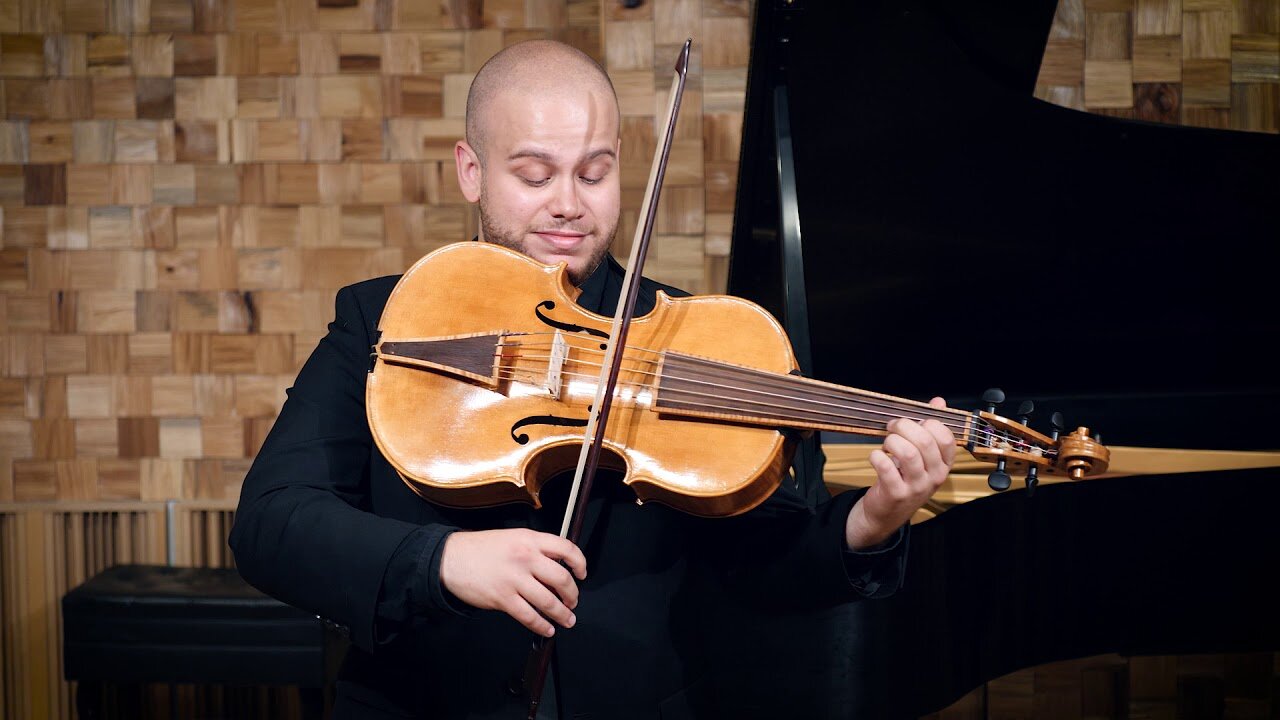
The violoncello da spalla is easily (a relative term) played by violinists and violists. Indeed, some experts believe that the instrument was invented in the early 1700s in order to minimize the learning curve of accomplished violinists and violists desiring to play a baritone range instrument.
Learning to bow the Violoncello da Spalla does not take much time at all, assuming pre-existing proficiency on viola. That being said, any, if not most, experienced violinists and fiddlers, whose experience is primarily in playing the lead melody, will probably need to brush up on their music theory, particularly the principles for improvising baritone/bass harmony and chords. Put another way, they will have to learn the mostly lost art of basso continuo. Of course, there are many fully-scored solo pieces for violoncello from the Baroque period, especially by J.S. Bach.
Interest in these newly re-discovered instruments is growing as part of an overall re-discovery of Baroque music and Baroque instruments, particularly those played with a bow.
Description of the Violoncello da Spalla by D. Rickert and its Options
The Violoncello da Spalla Standard Model is inspired by but not a copy of measurements taken from the surviving instrument by Johann Christian Hoffmann (1732) by Badiarov and others. As would be expected, our Violoncello da Spalla is 5-string instrument with a body length of 18 inches (14.5cm). It is tuned to C, G, d, a, e’ (i.e. C2 G2 D3 A3 E4). In other words, the tuning is the same as a full-size cello, but with an additional string on the treble side that is tuned to e’ (E4) (an octave lower than the e” (E5) string on a violin). It is held across the chest, suspended by a strap around the players neck, not unlike a modern guitar, but much closer to the chin (see the image of Andrew Gonzalez above).
Approximate Critical Dimensions
- Overall length: 30” (75cm)
- Body length: 18” (45.5cm)
- Upper bout width: 8.25” (21.5cm)
- Lower bout width: 10.25” (26cm)
- Ribs: 3.15” (8.0cm)
- Playable String length: 16.53” (42cm)
- Note about string length: The playable string length of this instrument requires a slightly disproportionately long neck length when compared to the “ideal” string and neck lengths of a modern 1/10 size cello or an 18” viola.
- Nut width and string spacing: 34mm with; 26mm spread with average of 6.5mm between strings
- Bridge string spacing: 2 3/8” (60.32 mm) string spread
Materials
- Top: Alpine or Carpathian Spruce
- Back and Ribs: Bosnian Maple
- Neck and Scroll: American or European Maple
Varnish
A number of varnish options are possible, everything from "blonde" to dark brown. My default is a medium-dark golden brown. Unless some special varnish formulation is negotiated, I use a spirit-based grounds (sealer) varnish, with many coats of spirit varnish and finished with 2 to 3 layers of clear(ish) hand-rubbed oil varnish. I generally use dye-based color rather than pigment, so as to maximize the appearance of wood figure. Dye is more transparent than pigment.
Setup: Baroque or modern
Nut and saddle: Off-white (ivory or bone colored) or black (ebony colored) GraphTech XL
- GraphTech XL is a self-lubricated polymer similar to bone; however, GraphTech XL is 500% more "slippery" than bone or ivory. It is has less friction than solid graphite. It looks wonderful and results in far less string breakage due to friction than bone or ebony. The off-white looks exactly like bone or fossil ivory. The black looks exactly like ebony.
Pegs: Wittner FineTune (default)
- FineTune(tm) pegs by Witttner are internally-geared tuning pegs that look identical to traditional ebony pegs. The gear ratio is 8.5:1, thus making tailpiece mounted fine-tuners unnecessary. I modify the Wittner pegs as necessary for use with either modern or gut strings.
- While I consider the Wittner FineTune pegs to be preferred option, traditional pegs, either modern or baroque style, are available for the Violoncello da Spalla Standard Model.
True veneered spruce Baroque fingerboard
A proper Baroque fingerboard is not made from either solid ebony or maple. Rather, it has a core of quarter-sawn spruce, which is then clad with thick veneers (2mm to 3.5mm) of various woods, including ebony and figured maple.
Baroque Tailpiece
A Baroque Tailpiece can be made from solid ebony or boxwood; however, Baroque tailpieces are more often made from maple, which is then veneered to match that of the fingerboard (see product images above).
Custom bridge for a Violoncello da Spalla
The default bridge is based on a treble viola da gamba bridge.
Strings
Standard String Set
For the past several years, the default string set has been the silk-core violoncello da spalla set by Atelier Boussoir (France). These will continue to be available for a slight extra charge. we are presently evaluating a modern technology string set by a US-based string maker. They will be initially available with a synthetic core and windings similar to D'Addario Pro-Arte strings. A braided steel core string similar to D'Addario Helicore is also planned. We are also, in collaboration with another Violoncello da Spalla maker, at other new string options.
Gut Strings
We know that some players want to play a Baroque period instrument replica that is strung only with the type of strings that were available in the early 18th Century. We understand the appeal of gut strings, despite their high cost and typically short life. So, if you are committed to gut, we’ve got you covered. If you indicate that you may want gut strings, we will contact you to discuss the best string set to meet your requirements. We can supply Aquila or Atelier Boussoir gut strings for violoncello da spalla for an additional charge. If you choose gut strings, you will definitely want at least one set of spare strings. At this time, sets are running between $300 and $400.
Note: if you are paying attention, you will have read between the lines and realize that I favor modern strings for most players, especially if you tune to the modern pitch standard (A=440 Hz).
Cases
The instrument comes with a padded soft case. We can supply a custom-made hard shell case. The current price for that is about $900 for a wooden case and $1600 for an ultra-light carbon fiber case.
We can also supply a custom-fit flight case (25 lbs weight) for about $350.
Bow
- The bow is your responsibility. If you like, we will find you the best deal possible for a Baroque cello bow in whatever price range you desire. Some players use a high-quality modern cello bow; however, that practice is becoming less popular. The least expensive good bows start at about $450, regardless of whether they are modern or baroque. Many players start out with a student-level Chinese-made baroque style bow, which costs about $200.
Where is the Instrument Made?
The most critical work in making our Violoncello da Spalla, including graduation, carving and setting the neck, varnishing, authentic Baroque fingerboard and tailpiece, peg fitting and setup is done in our workshop, which is located in Hiawassee, Georgia, USA.
Some work, notably the partial completion of the neck and scroll, if performed by one of several highly-trusted string instrument factories. The materials are the highest grade. The top is tightly-grained spruce, either Alpine or Carpathian. The back and sides are well-flamed maple, usually Bosnian, which is especially-prized for fine string instruments. The neck and scroll are generally flamed hard Maple.
Our utilization of proven contract labor for the initial body construction and scroll saves us several weeks of work. This is why we can offer our Violoncello da Spalla for of price of just over $10,000. If you wish to have an instrument made entirely in our Georgia, US workshops, please feel free to contact us. The base price is about $16,500 and the minimum wait currently is 6 months, but can be up to a year.


